Exploring the Relationships
Between Linguistic Arousal,
Emotional Tone,
and Sharing Behaviors (2023)
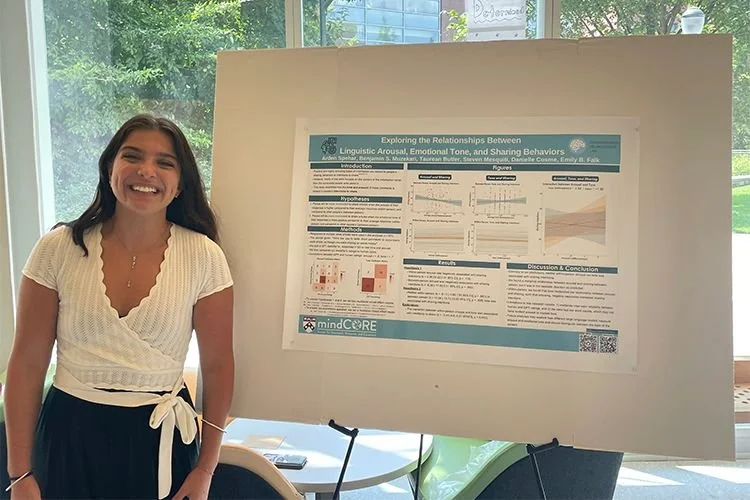
To learn more about this project, check out my presentation poster.
Timeline: June 2023 - August 2023
Skills:Independent research design, literature review and synthesis, RStudio, qualitative and quantitative reasoning, scientific writing, public speaking, project management.
Project Goals:
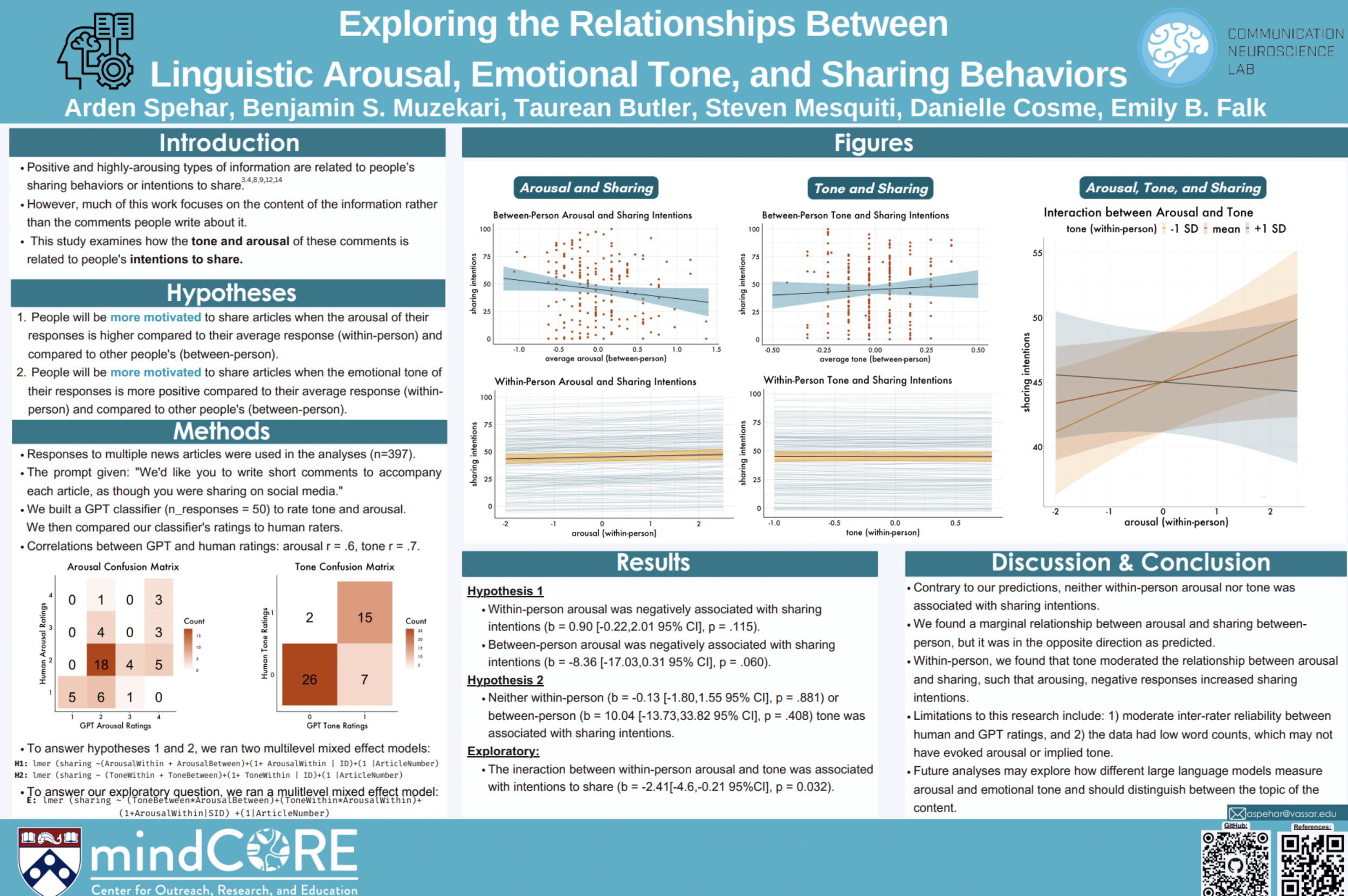
Investigate how emotional language (linguistic arousal and emotional tone) in people’s reflections on climate and health news predicts their intentions to share that content.
Compare within-person effects (how individuals share when their own responses are more emotional/positive than usual) to between-person differences (how people differ overall).
Evaluate self vs. social relevance prompts to understand how framing influences emotional expression and sharing motivation.
Use both human coders and GPT models to classify arousal and tone, assessing reliability across methods.
Key Takeaways
Neither within-person arousal (b = 0.90, 95% CI [–0.22, 2.01], p = .115) nor within-person tone (b = –0.13, 95% CI [–1.80, 1.55], p = .881) was significantly associated with sharing intentions.
Between-person arousal showed a marginal negative effect on sharing (b = –8.36, 95% CI [–17.03, 0.31], p = .060), indicating higher-arousal individuals were less likely to share—opposite the predicted direction.
Between-person tone was not significantly associated with sharing (b = 10.04, 95% CI [–13.73, 33.82], p = .408).
A significant arousal × tone interaction emerged: (b = –2.41, 95% CI [–4.6, –0.21], p = .032), showing that arousing, negative responses increased sharing intentions.
GPT–human rating agreement was moderate for both arousal (r = .6) and tone (r = .7), supporting computational linguistics approaches with human oversight.
Future Considerations
Improve GPT–human coding reliability to support scalable sentiment analysis for news and public-health messaging.
Test how broadcasting vs. narrowcasting shifts emotional predictors of sharing to inform platform-specific communication strategies.
Examine how negative, high-arousal language drives engagement to help design ethical, high-impact climate and health messaging.
Incorporate demographic and individual differences to guide inclusive communication campaigns.
Refine statistical models to better predict what content spreads, supporting misinformation prevention and evidence-based outreach.